
Dear Tim,
Where am I at? Online votes count! Do your part!
Yeah so I’ve figured out how to pass in an authorization token from the API Gateway into a python Lambda function; it turned out to be really simple:
user_id = event['requestContext']['authorizer']['claims']['sub']
constituency_id = event['requestContext']['authorizer']['claims']['custom:constituency']
Yep, turns out the event holds all that data for use. Fantastic. Now my API can gather a user’s votes, and post a user’s vote for specifically them. The election end has been extended until 5pm, so that gives time for a user to vote.
The difficulty has been making the frontend site work with the authentication flow. Being able to determine their authentication data is imperative for making the site look proper. After all, a /login form should not be visible if you’re already logged in. Seeing their user account page should not be possible if they’re not logged in. I need to determined if their email is confirmed, I need to change the button layout so it displays a login button if they’re not logged in.
Things are getting complicated and it’s not anything to do with the actual elections! It’s just the interaction!
I also had to take a look into the election and assembly logic and we’ve reached a tipping point: we’ve privatised almost EVERYTHING. Let’s take a look into why this might be:
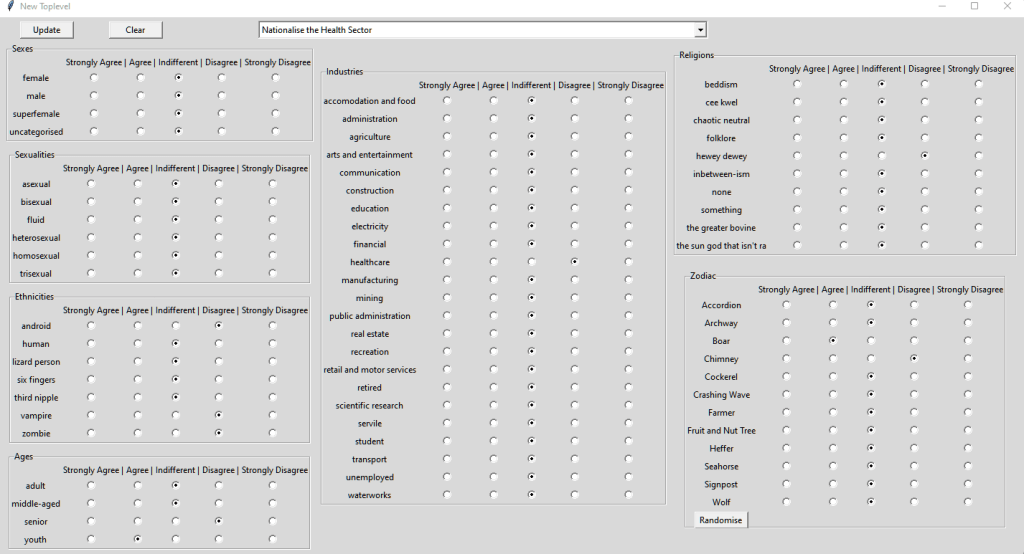
Yes, it’s a very basic GUI written in python. I just needed something to manage this a lot more efficiently that writing a new line into a database for each change, and then try to find them.
What we’re looking at is how I’ve programmed the preferences for the ‘Nationalise the Health Sector’ policy, and you can see that there’s not a lot going on for agrees. I think this is why my people are very conservative. This needs an update and you’ll see my update here:
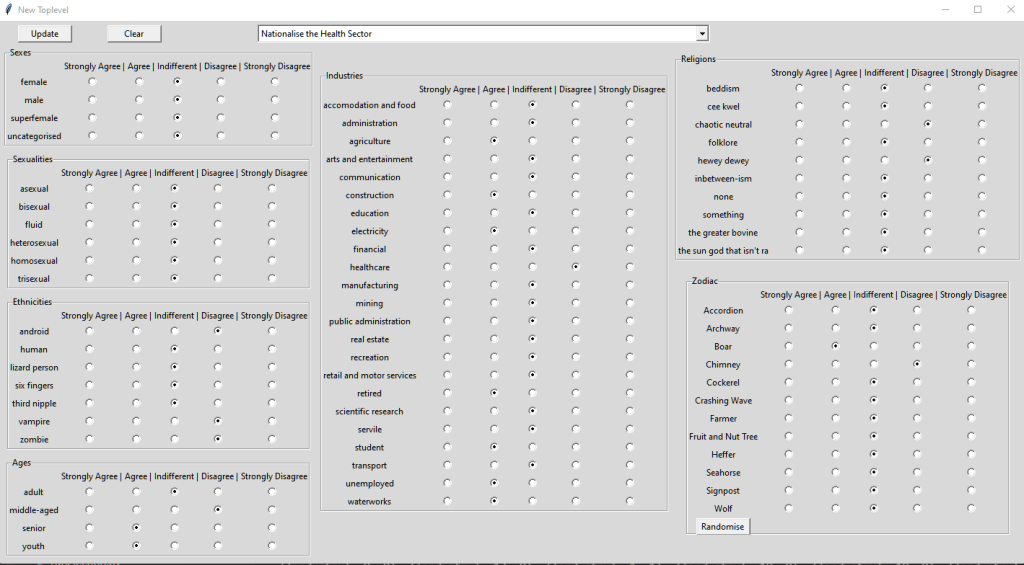
I’ve updated to make anyone who works in a “dangerous” industry to want national health (why would they want to pay for privatised healthcare?) and anyone receive benefits as they definitiely don’t want to spend money. Seniors are switched to be pro-nationalisation as they are the most afflicted by health conditions, but middle-aged, the least trusting generation, are switched to be more for privatisation.
By looking at the demographics before, I could see that a good 17% of people were against nationalisation, and so by complicating the matter now it’s made the playing field a lot more even. It also still makes sense which is what I want. You might think, ‘why would anyone working in healthcare want privatisation?’. Well because they can potentially make more money, we all know the benefits. When an industry is nationalised, we’re looking at a lot less in terms of profits and we’re no longer profit driven.
This does mean in my Capitalist update we’re going to overhaul the whole system – privatisation will switch from basically just a ‘whether the government controls that sector of policies’ to ‘whether companies can operate in that particular industry’. In which case, the policies will no longer be ‘privatise Business & Industry’ but ‘privatise the Finance Industry’ or ‘privatise the Mining Industry’. It’ll be major and we’ll no longer have it affect the politics of making sure that regulations are followed.
There’ll also need to be an overhaul to industries – I don’t want ‘accommodation and food’ to be conglomerate. At that point, we’ll be dealing with individual product types to identify if a citizen wants that product.
This was something I was considering yesterday: how would the capitalist update work?
First off – we are tracking an economy. We’re dealing with currency, so every citizen needs a record of how much money they current have; their savings. Then we also need to track the government’s account and then the government mint that can print legal tender. Whenever the government has a deficit, we either print more money, or we borrow it. So we’ll need some logic there.
Each day, every citizen will spend money on services they want/need. This is where the product type will come into play. Each citizen will also work at their job and produce a product that enters a company’s assets.
And that’s where I’ll need company objects to manage assets and jobs. We’ll need a job market to track unoccupied jobs. In their abstraction, they’ll have numeric products regardless unless I separate services from commodities. And companies will have founders that get to manage their salary based off company profits. Prices will follow the free market style of the supply/demand law.
And THEN we also need to track VAT and Income Tax, and Cooporate Tax. It’s going to end up quite an amalgamation of logic.
I realise all that is a lot – breaking it up into tasks requires a full design document I think. I basically just splurged a lot of ideas above to get them out but if you have anything I could interpret, throw it to me.
It would benefit from my time update coming first so I might prioritise that before this. Location will definitely complicate things as commutes will become complicated.
Anyway, the main thing is that we’re close to a beta. All I need is to clean-up the auth system and make it look better as currently we’ve got too many niggling things; I throw alerts to show that a login succeeded or errors; I don’t redirect properly; I don’t track the authentication information properly; I don’t auto-fill the email confirmation; I don’t allow you to retrieve a forgotten password; THERE’S A LOT MISSING.
Anyway, wrapping up, I hear they’re building a mecha in Hong Kong and I can only assume it’s to fight what you found in the ocean. If you need the inscription translated, check with Li Eng, down in the Fire District. He may be able to do it, but if he can’t, you’ll have to find the crystal of Wood Chi on your own. Let me know when you want the GPS system reactivated – I’ve left it off since the altercation in Chile.
Yours,
Stan

 WoodenSocks